A strapping specification can remain in place long after the conditions that shaped it have changed. A width, thickness, and break strength that performed reliably years ago may no longer be the most efficient choice as packaging materials, tooling, and distribution requirements evolve.
Right-sizing replaces habit with application data. The goal is to secure the load throughout its journey while eliminating strap thickness, width, or quantity that adds cost without improving performance.
Begin With the Load
The first question is not which strap to buy, but what the strap must accomplish within the package. On a pallet of corrugated cartons, the strap stabilizes cases and secures them to the pallet. Around a lumber bundle, it becomes part of the package itself, holding individual boards together as a single unit. Loads of equal weight can place very different demands on the strap.
Load geometry and compressibility also affect performance. Round or irregular products create less predictable pressure points and greater opportunity for movement. Corrugated cases and other compressible products may settle after strapping, especially when pallets are stacked. As load height changes, original strap tension declines. Dense products may settle less, but their weight and hard edges can increase the force the strap must withstand.
Load weight provides a starting point for estimating required break strength. A common guideline is to apply a 50 percent safety factor: multiply the total load weight by 1.5, then divide the result across the planned number of straps. The result is an initial requirement, not a final specification. Packaging teams must also consider strap placement, the product’s response to tension, handling conditions, and the consequences if the load shifts or separates.
Storage and transportation conditions further refine the calculation. A pallet shipped within hours faces different forces than one held for months. Repeated transfers, stacking, and freight handling can be more significant than travel distance because each event can affect load compression, strap tension, and package stability.
Nominal Break Strength Is Not Enough
Published break strength describes an individual piece of strap before its ends are joined. In an applied package, the joint is generally the weakest point in the loop.
Steel strapping applied with manual tools and mechanical seals often retains about 60 to 65 percent of nominal break strength at the joint. Polyester applied with a properly matched friction-weld tool can achieve roughly 80 to 85 percent joint efficiency.
For example, consider 5/8-inch by 0.023-inch round-edge steel strapping with a nominal break strength of 1,690 pounds and 5/8-inch by 0.035-inch polyester strapping with a nominal break strength of 1,400 pounds. At 65 percent joint efficiency, the steel loop provides approximately 1,099 pounds of strength at the joint. At 80 percent joint efficiency, the polyester loop provides approximately 1,120 pounds. Although the polyester has a lower nominal break strength, it provides slightly greater strength at the completed joint.
Applied tension matters as well. Polyester stretches within a controlled working range and recovers as the load settles or shifts, helping it maintain contact with products whose dimensions change during storage and transit.
Gauge affects how readily the material enters that working range. With properly matched equipment and settings, a lighter polyester strap may operate at a higher percentage of its break strength than a heavier gauge. It may therefore deliver greater elongation recovery and better retained tension. More material does not automatically produce a more stable load.
Equipment Enables Reduction
A right-sized specification works only when the application process produces repeatable tension and joint quality. Manual tensioning depends heavily on operator technique. Variations in tension, seal placement, and tool handling can weaken the completed loop. Failed seals also require operators to cut away strap and start again, creating scrap and lost time.
Friction-weld tools reduce this variability by combining tensioning, welding, and cutting in one process. Programmable settings help operators apply more consistent tension, while friction welding eliminates separate metal seals.
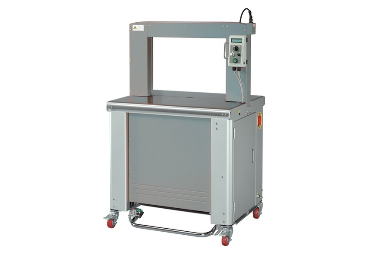
Automatic strapping equipment extends that control by feeding a defined amount of material around the package, tensioning it to a repeatable setting, and completing the joint without manual measurement. This can reduce excess strap, seal-related scrap, and application errors.
The labor impact can be significant. Replacing separate manual tensioning, sealing, and cutting steps with a battery-powered friction-weld tool can reduce handling time per load, minimize rework from failed seals, and simplify operator training. In higher-volume operations, those labor savings can contribute materially to the return on the tooling investment.
Modern polyester manufacturing supports the same objective. Tighter control over resin processing, orientation, and finished dimensions helps manufacturers produce consistent material properties. Still, laboratory values should guide the evaluation, not replace application testing on the actual load.
Case Study: A System-Level Review
PAC Strapping used this application-based approach when a major national retailer reevaluated the steel strapping used on store replenishment orders. The retailer’s existing 1,180-pound steel strap had been specified years earlier based on the tooling and operational requirements available at that time. Advances in polyester strapping and battery-tool performance created an opportunity to reassess the full system.
PAC conducted remote discovery meetings and observed the packaging process at the retailer’s distribution centers. The review considered worker safety, application time, material cost, freight damage, load weight, storage conditions, handling practices, and the distribution environment.
PAC recommended a 5/8-inch-wide by 0.030-inch-thick polyester strap rated at 1,100 pounds. While the polyester had a slightly lower nominal break strength than the steel, the completed loop was stronger at the joint. At 65 percent efficiency, the mechanically sealed steel loop provided approximately 767 pounds of joint strength. At 80 percent efficiency, the friction-welded polyester loop provided approximately 880 pounds. Polyester’s elastic recovery also helped it remain engaged as loads settled during shipment.
The teams then conducted extended trials at distribution centers and shipped replenishment orders through the retailer’s normal network. The trial allowed them to assess performance under real storage, handling, and transportation conditions.
The results extended beyond material reduction. Eliminating steel reduced the need for workers to handle sharp metal strapping. The all-in-one battery tool replaced separate tensioners, sealers, seals, and cutters, helping operators complete applications more quickly and consistently. Improved tension retention also helped reduce freight damage during trial shipments.
The project generated savings in the hundreds of thousands of dollars, even after the retailer invested in battery tools for its facilities. The exact payback calculation should combine the annual difference in steel and PET material purchases, eliminated seal costs, reduced scrap, labor-time savings per load, and any freight-damage reduction. Dividing the installed cost of the battery tools by those documented annual savings provides a practical payback period. For a high-volume operation, the combined material and labor savings can allow tooling to pay for itself relatively quickly.
Move Beyond Legacy Specifications
A strapping specification should be reviewed when the product, pallet configuration, storage method, shipping route, or application equipment changes. Past performance confirms that a system has worked; it does not prove that every pound of break strength, increment of thickness, or extra process step remains necessary.
Packaging teams should not let “the way it has always been done” determine how they move forward. Steel strapping technology served many applications effectively, but modern polyester systems can offer a more efficient, safer, and more consistent approach when matched to the load, joint, equipment, and distribution environment.
Right-sizing makes material reduction the result of stronger application control, rather than an isolated cost-cutting exercise. A validated system can use less material, eliminate unnecessary components, reduce labor, and maintain the load security required to protect products through the supply chain.
Also Featured On: